

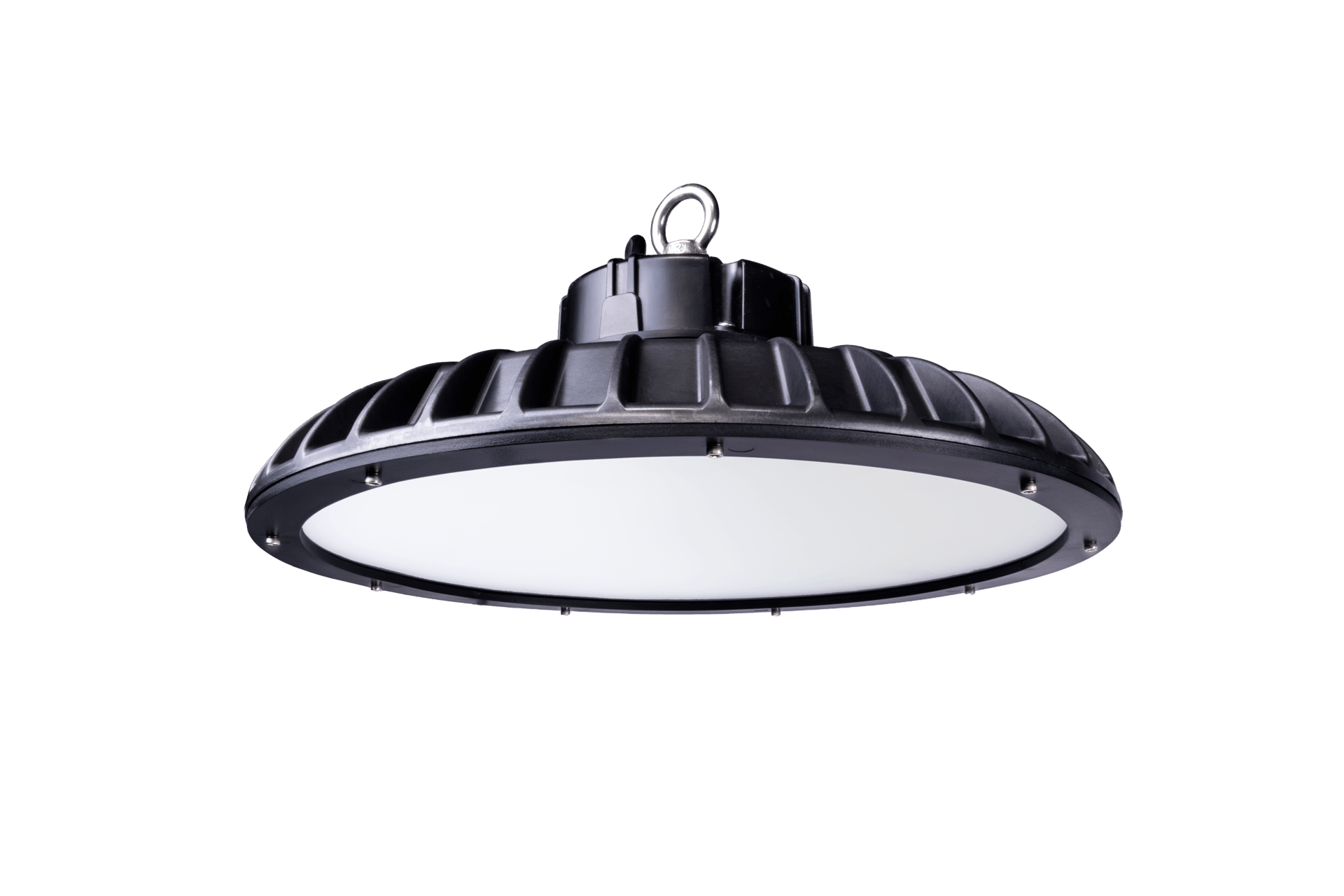
CircLED™ Round LED High Bay Light Thermal Polymer Fixture
Features and Benefits
- A lightweight alternative to die-cast fixtures, weighing just 15 lbs.*
- Damp location rated for protection against moisture.
- Thermally conductive polymer housing ensures superior heat dissipation and a long operational lifespan.
- Contractor-friendly and easy to install.
- Designed for use with a round LED PCB module and can accommodate an occupancy sensor.
- Available with a flat lens glass in clear or frosted.
Overview
The CircLED™ high bay is a high-performance lighting solution for industrial and commercial use. Constructed from a thermally conductive molded polymer, its design offers a lighter alternative to traditional die-cast fixtures while ensuring optimal thermal management. The fixture carries a damp location listing, so it holds up in humid and condensation-prone spaces like warehouses, loading docks, and
cooler entryways. Wondering why molded polymer beats die-cast aluminum? See the FAQ below.
Applications
- Manufacturing, warehouse, and distribution facilities
- Automotive repair shops and service bays
- Aircraft hangers with vibration and temperature extremes
- Industrial laundries and textile facilities
- Metal fabrication shops with welding operations
- Gymnasiums and University buildings
- Electronics manufacturing clean rooms
Certifications


Specification Table
| Ambient Operating Temperature | -30 to 50 °C (-22 to 122 °F) | Beam Angle | 120° |
| Certifications/Compliance | UL 1598, Made in USA | CCT | 4000K, 5000K |
| CRI | 80 CRI, 90 CRI | Dimmable | Yes |
| Diameter | 18 inches | Driver | Meanwell |
| Environmental Rating | Damp Location Rated | Housing Material | Thermally Conductive Molded Polymer |
| Input Connection | 3/4" NPT/M20 Cord Grip | Lens Options | Clear Glass, Frosted Glass |
| Lumens | Varies by Configuration | Mounting | Eyebolt |
| Operating Voltage | Universal (120-277 VAC) or High Voltage (347-480 VAC) | Optional Features | Emergency Backup (30W), White Wall Diffuse Reflector, Remote Box |
| Product Type | Round LED High Bay Light | Weight | 15 lbs |
| Wattage Options | Varies by Configuration | Warranty | Contact Manufacturer |


FAQ
Why polymer instead of die-cast aluminum?
The housing is the heat sink, molded from Makrolon TC621 instead of cast metal. Covestro simulated and tested it to 200 watts.
Doesn't aluminum conduct heat better?
Yes, 80 to 160 W/m·K against TC621's 16. But a UFO high bay cools in still air, and metal can't use conductivity the air won't carry away.
Isn't a plastic heat sink a warning sign?
Ordinary plastic conducts 0.2 W/m·K. TC621 conducts 16, and in published testing a 20 W/m·K housing ran two to five degrees hotter than the aluminum it replaced.
How does a plastic conduct heat?
Graphite, the same material in a pencil, is compounded into the polycarbonate. It pulls heat off the board and spreads it across the fins.
What is pot metal?
Cheap castings made from whatever scrap alloy runs cheapest, often zinc-heavy. Imported UFO high bays rarely name the alloy, so you can't look up its conductivity.
Why does housing temperature matter?
LED life drops from 80,000 hours to 20,000 between 115°C and 135°C. The housing controls that number.
Does molding change the fins?
Die-cast fins are limited by what the tool can release. Molding shapes them for airflow.
Will polymer melt or burn?
TC621 is UL 94 V-0 at 2.0 mm and holds shape to 125°C. It's f1 rated under UL 746C for UV and moisture.
Does the housing corrode?
No. There's no metal in the housing to oxidize, so salt air and washdown humidity don't pit or rust it.